

Here Is How to Make Sure Yours Is Not One of Them.
Seventy-two percent. That is the proportion of digital transformation initiatives that fail to achieve their objectives, according to research from McKinsey, BCG, Gartner, and Forrester. More than seven out of ten.
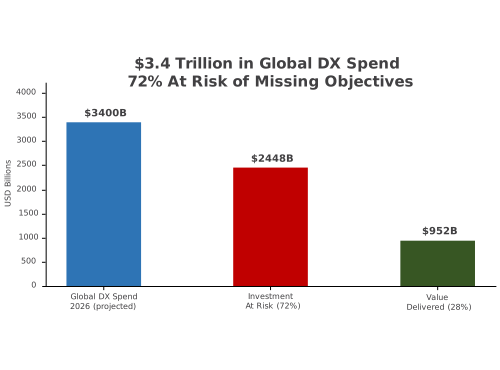
Global investment in digital transformation is projected to reach $3.4 trillion in 2026. Yet most of it will not deliver its intended value. For US enterprises navigating rapid technological change, rising competitive pressure, and growing expectations around AI adoption, the cost of a failed transformation extends well beyond wasted budget.
The question is not whether to transform. The question is how to be in the 28 percent that actually succeed.
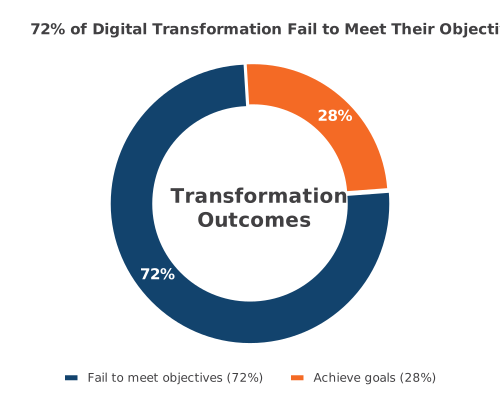
Digital transformation does not fail because the vision is wrong. It fails because execution is flawed.
Why the Failure Rate Has Not Improved
The 72 percent figure has appeared in research for nearly a decade, across different methodologies and industries. That consistency tells us something important: the problem is not a lack of technology options. It is a pattern of execution failures that organizations keep repeating regardless of which platform or vendor they choose.
Bain found that 88 percent of business transformations fail to achieve their original ambitions. Gartner reported that 85 percent will not scale beyond pilot stage. These numbers converge on the same issue: the gap between what organizations plan and what they are equipped to execute.
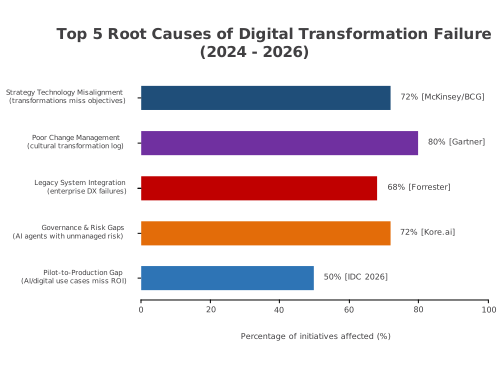
1. Strategy Before Technology
Choosing a platform before defining the problem leads to expensive experiments with no measurable outcome. Technology should follow strategy, not lead it.
2. Legacy System Integration
Forrester found that 68 percent of enterprise transformations fail due to integration issues. Most US enterprises run on many disconnected systems accumulated over years. Introducing a new solution without an integration plan creates another silo rather than a step forward.
3. Poor Change Management
Technology does not transform businesses. People do. Employee resistance, weak leadership alignment, and unclear communication can stop even a technically sound implementation before it delivers value.
4. Governance Gaps
Without clear accountability, audit trails, and performance metrics, transformation projects drift. Timelines slip, scope expands, and no one has the authority to course-correct.
5. The Pilot-to-Production Gap
IDC projects that nearly 50 percent of AI-driven digital use cases will miss ROI targets in 2026. Organizations succeed in controlled pilots but stall when scaling to the full enterprise. This is where value goes to die.
The pilot-to-production gap is where most enterprise AI and digital projects quietly fail, not in the boardroom, but in the reality of deployment at scale.
The Scale of Investment at Risk
At a 72 percent failure rate, approximately $2.4 trillion of global DX investment in 2026 is at risk of missing its intended value. For US enterprises, the stakes are clear. In an environment where competitors are investing heavily in AI, cloud, and automation, a failed transformation does not just cost money. It costs market position.
What the 28 Percent Do Differently
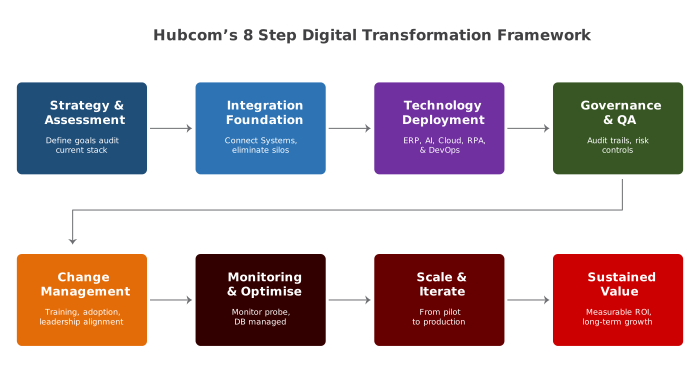
Successful enterprises share a structured approach to execution, not access to better technology. Based on over a decade of delivering transformation projects across the US and globally, Hubcom has built a framework around the eight failure points that most consistently derail initiatives.
- Strategy and Assessment: Define measurable outcomes before selecting any platform.
- Integration Foundation: Connect legacy and modern systems before deploying new capabilities.
- Technology Deployment: Implement ERP, AI, Cloud, RPA, and DevOps in the right sequence.
- Governance and QA: Build audit trails and risk controls from day one.
- Change Management: Train people and align leadership throughout delivery, not just at go-live.
- Monitoring and Optimization: Use real-time monitoring to keep systems healthy post-launch.
- Scale and Iterate: Move from pilot to production with infrastructure already in place.
- Sustained Value: Measure ROI continuously. Transformation is not a project with an end date.
Key Takeaways
- 72 to 88 percent of digital transformation initiatives fail to meet their objectives.
- The top causes are strategy-technology misalignment, integration failures, poor change management, governance gaps, and the pilot-to-production gap.
- $2.4 trillion of 2026 DX investment is at risk of missing its intended value.
- The 28 percent that succeed define outcomes before selecting technology and treat integration and change management as core workstreams.
- The right partner brings methodology and cross-functional depth, not just a product.
If your organization is planning a transformation or trying to unlock value from one that has stalled, the right conversation starts with an honest assessment of where you are.