

Zero Trust Is No Longer Optional: Why US Enterprises Are Rebuilding Security from the Ground Up
The old model of enterprise security was simple: trust everything inside the network, block everything outside. Build a strong enough wall and you are safe.
That model is broken. The modern enterprise has no clear perimeter. Employees work from anywhere. Applications run across multiple clouds. And attackers no longer breach walls they steal credentials, walk through the front door, and move quietly until they find what they are looking for.
Zero trust is the security framework the industry has converged on. Not a product. Not a single tool. A fundamentally different approach built on one principle: never trust, always verify.
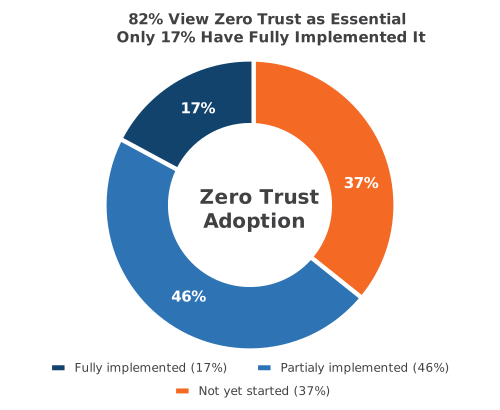
82% of organizations say zero trust is essential. Only 17% have fully implemented it. That gap is where breaches happen.
Why the Perimeter Model Failed
Three shifts broke traditional security permanently. Cloud adoption moved applications and data outside the perimeter. Remote and hybrid work moved employees outside it too. And attackers discovered that credential theft is far easier than breaking through a firewall.
The result: 22 percent of all data breaches in 2025 started with stolen credentials, according to the Verizon 2025 Data Breach Investigations Report. Stolen credentials also drove 88 percent of web application attacks. The perimeter was bypassed long before anyone inside knew it had happened.
What Zero Trust Actually Means
Zero trust is a security framework built on three principles.
Verify Explicitly
Every access request from any user, any device, any location must be authenticated and authorized every time. No free passes because someone is on the corporate network.
Least Privilege Access
Users and systems get access only to what they need for the specific task at hand. If an attacker compromises an account, least privilege limits what they can reach. Lateral movement becomes dramatically harder.
Assume Breach
Zero trust operates on the assumption that a breach has already occurred or will occur. The focus shifts from preventing entry to detecting and containing threats quickly.
The Business Case
IBM’s 2025 Cost of a Data Breach Report found that organizations with mature zero trust programs saved an average of $1.76 million per breach compared to those without. At an average breach cost of $4.88 million, that saving represents more than a third of the total damage.
Organizations with ungoverned AI in their environments paid roughly $670,000 more per breach on average — a growing risk as enterprises deploy AI agents and automation tools without proper access controls. Zero trust principles extend naturally to AI workloads, which is why it has become one of the fastest growing security priorities in 2026.
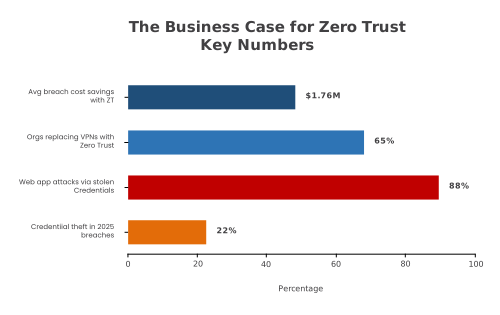
Zero trust organizations saved $1.76 million per breach on average in 2025. That is not a security budget line. That is a business outcome.
Why Most US Enterprises Are Still Not There
Despite the clear case, only 17 percent of organizations have fully implemented zero trust. The reasons are consistent.
- Legacy infrastructure was never designed for identity-based access and is complex to retrofit.
- Integration complexity across hybrid and multi-cloud environments makes unified policy enforcement difficult.
- Skills shortage: architects experienced enough to run a full implementation are in short supply.
- Scope confusion: many organizations buy a zero trust product and believe they are done. Zero trust is an architecture, not a checkbox.
Gartner projects that even by the end of 2026, only 10 percent of large enterprises will have a mature, measurable zero trust program in place — despite most claiming to be doing zero trust already.
Where to Start
- Identity first: implement phishing-resistant multi-factor authentication across all users. This closes the most common initial access vector immediately.
- Inventory every device: you cannot secure what you cannot see. Classify devices by risk and apply access policies accordingly.
- Apply least privilege: audit and remove permissions that are not actively needed. Limit the blast radius of any future compromise.
- Segment your network: micro-segmentation contains lateral movement and gives security teams time to detect and respond.
- Monitor continuously: zero trust is not a one-time configuration. Ongoing visibility into user behavior and network traffic is what turns breach containment from hours into minutes.
How Hubcom Helps
At Hubcom, security is a design principle across everything we build and integrate. BURD, our intelligent security and integration platform, provides real-time monitoring, access control, and integration with your existing technology stack — built to protect enterprise operations at scale across healthcare, manufacturing, financial services, and logistics.
Our Integration Services team addresses one of the biggest zero trust blockers directly: disconnected systems that make unified policy enforcement impossible. We connect your tools, data pipelines, and security controls into a coherent architecture that zero trust can actually run on.
If your organization is assessing zero trust readiness or planning an implementation, our security and integration team can help you build a roadmap that fits your environment, budget, and timeline.